Last night, we watched the rodeo at the National Western Stock Show while enjoying a local Colorado brew. The mutton bustin‘ was pretty cute.


Last night, we watched the rodeo at the National Western Stock Show while enjoying a local Colorado brew. The mutton bustin‘ was pretty cute.
So, we survived our trip and really ran into surprisingly few issues. We both lost our Fitbits, we each ended up on Pepto-Bismol for a few days in a row, and we both caught a 40-day cough that started around Kenya. But, really, nothing major. A few days before the trip was up we kept discussing how shocked we were that not much had gone wrong (knock on wood) — no issues with Visas or border crossings, and nothing major had been stolen — but then we learned about the biggest FAIL of our trip. Luckily, it still falls into the category of #firstworldproblems, but it was our “travel disaster” — and something other travelers should be careful about — a stolen SIM card ran up about $1000 of roaming calls in Tanzania, Africa.

TL;DR: We are on T-Mobile, which has great roaming and data in 120 countries. It worked great in Asia, but struggled in many countries in Africa. So, in Africa, we often bought local SIM cards since T-Mobile either didn’t work, barely worked, or had excessive costs. After swapping SIM cards at some point, we lost one of our T-Mobile SIMs. Someone found it, or or stole it, and ran up a massive bill.
We contend that we are not liable for the entirety of these bills for two reasons.
1) As soon as we had internet access once we noticed that the SIM card was missing, we suspended the lost card.
2) Though the unusual usage was not visible to us via the online system, T-Mobile had noted the unusual usage, but did not notify us about it (as required to in the FCC’s bill shock agreement), despite the fact that charges were quickly adding up to 10X our normal bill. T-Mobile has both of our email addresses, and another phone line connected to the account. The only method of notification that they used was to SMS the STOLEN PHONE NUMBER about odd usage patterns!
Legally, in this situation, T-Mobile has no further obligations and can pass the entire cost onto the consumer. After hours of back and forth, T-Mobile, as a courtesy, covered 2/3 of the charges, while we agreed to pay 1/3. Still costing us over 3X more than our standard monthly bill.
While our specific problem was with T-Mobile, this is a problem with all US mobile providers. There isn’t strong consumer protection laws for stolen charges, like those that exist for credit cards. There are ways to help prevent this, the best way is add a SIM PIN lock. You can read how to lock a SIM on Android, or lock a SIM on IOS. You can also avoid issues by having pre-paid SIMs which is what much of the world uses. T-Mobile, however, does not allow their pre-paid plan to be used internationally.
As we traveled around, we were swapping our SIMS often. We are on a 24 day overland Safari that went in and out of Kenya, Uganda, and Tanzania. One evening when swapping SIMs we noticed that we couldn’t find one of our original T-mobile SIMS. Considering we had been moving bags every day as we setup and tore down our tents, we figured it got left in the tent of left in one of our bags. It was dark, after sunset, so we figured we could search for it tomorrow. The next day with light we sorted through our tent and bags but couldn’t find it. We decided we should deactivate it just to be safe. Although we couldn’t do that immediately because driving around east Africa means you are often out of cell reception. Later that day we suspended the SIM and noticed no odd usage being reported online with our T-mobile account. We thought no worries we likely just misplaced it and it will turn up… It didn’t , but with no usage showing and it being suspended we didn’t worry about it.
Fast forward about a month when we have better internet and are checking our bank accounts, bills, etc… Logging into T-Mobile we notice our bill is for about $1000, which is around 10X our normal bill. The usage shows tons of roaming charges over 3 days or so in Tanzania up until we suspended the number. At this point we are in South Africa, and afraid of using T-mobile in case we incur further excessive charges. We use the T-mobile online chat to contact them. Originally offered a $50 credit adjustment, eventually explaining the case a bit further we are offered a $250 credit adjustment. We claimed they need to be responsible for consumer protections and contact us opposed to allowing the completely abnormal usage. We are told they sent a abnormal usage warning as a SMS to the stolen phone number. Considering the overage usage notice is legally enforced, I feel like T-Mobile isn’t fulfilling their requirements in contacting us. Opposed to SMSing the stolen number, we have two phone lines and two emails on file, I consider messaging the stolen number both insufficient and incompetent. The number they contact is always the primary number on the account, so if you loose a phone or SIM card, it is just dumb luck if they will contact an appropriate other number. After using online chat, twitter, and calling T-Mobile when I got back in the states, they accepted my offer that we could stay customers and not cancel our account if they would cover 2/3rds of the cost while we would cover 1/3. I do assume some responsibility because we should have contacted them sooner — though where we were in Africa without power or internet it was very difficult to do so. While traveling, we also definitely should have PIN locked our SIM cards (I didn’t previously know about that). So in the end we had an extra 3.5X mobile bill to cover, which considering all the craziness of travel isn’t too bad.
I really blame the mobile industry for most of this mess. The one thing I entirely blame T-Mobile for is how poorly they handle the customer support for this situation. My chat transcripts are almost comically sad, and are just this side of someone trying to cancel a Comcast account. The time we spent trying to deal with T-Mobile to come to an agreement was almost more annoying than the charges. As they offer to buy out contracts to acquire new customers at $350 per line. They didn’t seem willing to put $600 towards keeping two customers happy. In the end, after lots of escalating discussion while trying to pack up and return to the US, we ended up where I wanted to be. I had suggested the 1/3 and 2/3 break down about a hour into our first discussion, we wasted days of back and forth and and stress before we could reach a agreement. At one point in a odd move, a support rep tried to revoke a offer $250, credit and only offer $50, because he thought all the charges should be valid. This was an absolutely terrible move, which nearly made me cancel both lines on the spot.
1) Make sure you know which number is your primary account and if anything happens to that phone or SIM card report it immediately.
2) If you are swapping SIM cards or traveling set up a PIN lock (lock a SIM on Android, or lock a SIM on IOS). If you can use a prepaid mobile service (I was using prepaid T-Mobile, but switched to post-pay because pre-pay doesn’t include ANY of the international roaming).
3) If you end up having what you consider unauthorized charges that your provider is forcing you to pay, file a online complaint, as the bill shock protections means they should have at least notified you about unusual billing. Also, it is hard to estimate how much mobile providers are overcharging customers until the FCC gathers enough complaints to have a better idea of how common this is. From the bill shock site, “If you have tried to resolve a billing issue with your carrier and cannot reach an acceptable resolution, you may complain to the FCC.”
I still think T-Mobile is actually one of the best mobile companies in terms of consumer friendly policies. T-Mobile’s 120+ roaming free countries is pretty amazing. It isn’t always as fast for data and doesn’t always have the best coverage, but it worked very well for us, especially in Asia. It saved us from having to deal with and buy SIM cards in every country and considering we were in some countries for less than 5 full days, that is really helpful.
I don’t blame T-Mobile for the bad policy and protections specifically. I blame ALL US mobile providers (lobbying as CTIA). I think the entire mobile industry is exploiting the weak consumer protect laws and profiting on stole phone and SIM charges. Offering inadequate, inconvenient, and poorly implemented consumer protects to prevent charges like this from occurring. If you are curious and want to know more, or how to help improve protections take a look at the various links, resources, and stories below.
a stolen phone leads to a £1,700 Orange mobile bill.
a stolen phone leads to a $1000 Vodafone bill.
T-mobile fined for cramming charges on bills.
Sprint sued for cramming charges.
AT&T has phone insurance that doesn’t really cover what you think (like theft).
The Consumer Financial Protection Bureau, requested the FCC look into mobile providers services. The FCC found 5 issues, the first two are (1) the potential liability for unauthorized charges using prepaid or stored value products; (2) the unfair billing practices on mobile carrier bills; both of which the CTIA, has been dodging since 2011 at least.
Lobbying against net neutrality for mobile providers.
The CTIA (mobile provider lobbying group), has been avoiding cramming on all providers for years (what is cramming?).
Mobile industry has lots of warnings about the lack of consumer protect for mobile payments.
in fact the Consumers Union is calling for better protection including limited liability for lost and stolen phones (and being able to set a monthly cap which cuts off costs).
Opposed to having laws that might limit them, they push weaker voluntary commitments as the solution to these problems (which means when they fail you have no actual legal recourse).
In fact the often cited in this post bill shock consumer protections, aren’t a law but another ‘voluntary commitment’. Which really weakens consumers legal standing.
Follow various FTC complaints about the mobile industry.
Amurica!!

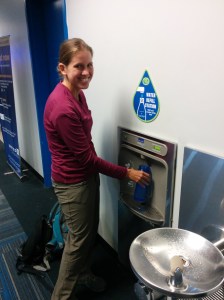
Brushing your teeth with tap water and being able to fill a glass from any faucet dramatically simplifies your life, and it is a rare privilege around the world.
In related news, changing all of the accidentally held-over currency from our adventure (well, except for money from Ghana, Egypt, and Tanzania, which couldn’t be changed) covered breakfast at Dulles airport and one round of cocktails in Denver.
Though we are home, we plan to continue updating the blog for some time as we catch up with drafts that we haven’t gotten published, so stay tuned for more travel stories and tips.
Actually, it was diving in a fish tank.
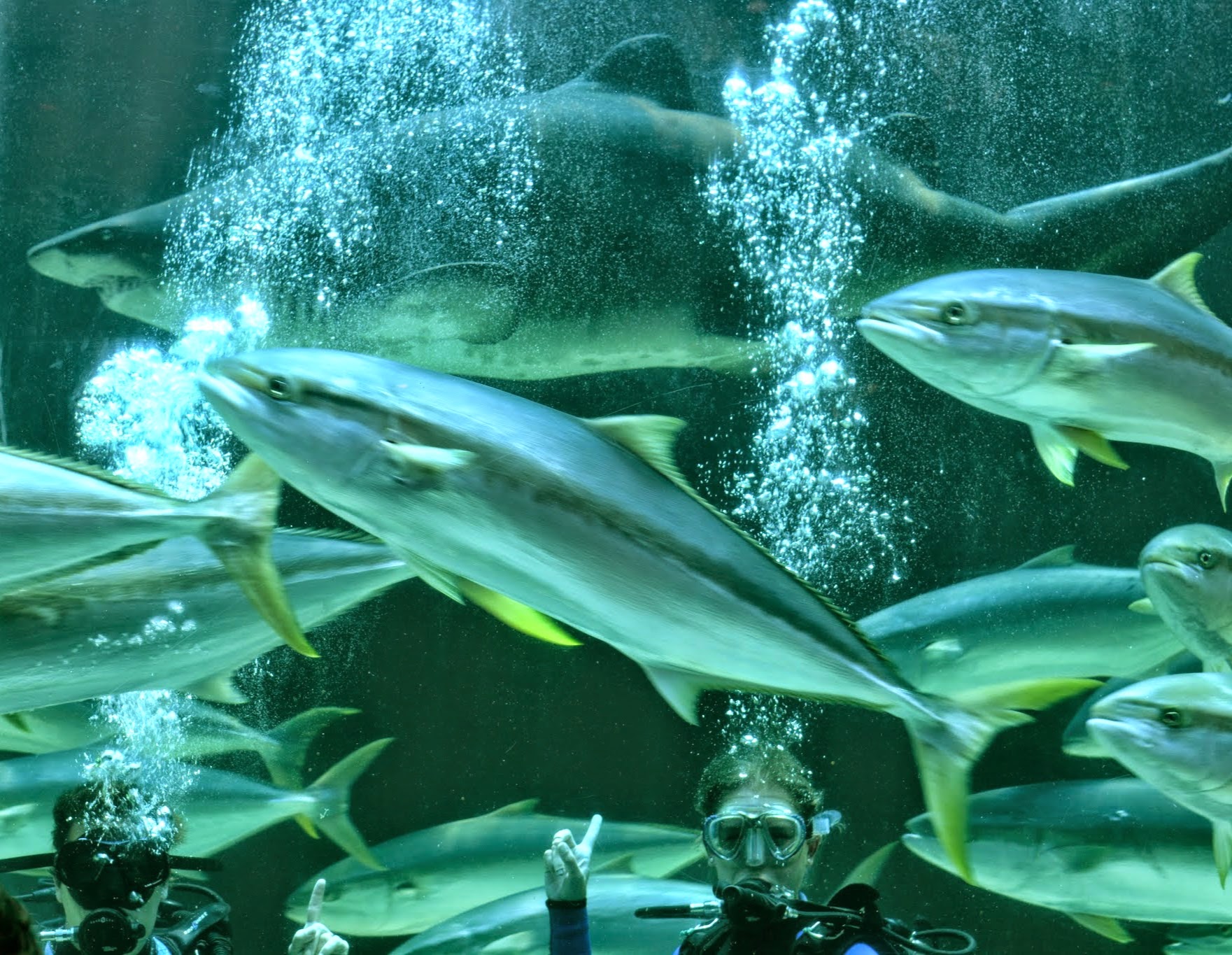
Yesterday morning, we went diving in a shark tank, for the second time. Really. It probably says something that we both found the concept of strapping on some compressed air and fins and jumping into tank occupied by three female ragged-tooth sharks to be less stressful than our impending return to the “real world.”
We are a bit sad to be letting this cat out of the bag (this was one of the few activities that was still available for booking during the infamously crowded Christmas-to-New Years week in Cape Town), but if you are certified diver visiting Cape Town, you really should look into the diving at the Two Oceans Aquarium. It is substantially cheaper than the caged shark dives down on the coast and with substantially less time spent in transit, both in buses and on boats, and you aren’t in a cage. Though it is also true that they are not feeding the sharks while you are in the tank.
The sharks at the aquarium are fed once a week, on Sundays. So the sharks are really full in the beginning of the week and less full as the week goes on. The sharks are also surrounded by some of their favorite prey, yellowtails, so if they do get hungry they will go for a yellowtail fish way before they think about going after one of the divers. And yes, sometimes the sharks do get hungry or bored or annoyed and take a nip out of one of the yellowtails, they have even killed and eaten a few. The ones with small wounds from the nips are called “survivors” and yes, they keep swimming around in the tank. During our second dive, one of the sharks reversed swimming direction and got annoyed at one of the yellowtails in its path and took a quick bite — clearly just a warning. The sharks spend 2-3 years in the tank before being re-released to the wild.
The sharks swim at a pretty constant altitude, so we had to be careful to stay very low to the ground while swimming. But it’s still harder to to keep your eyes on your sixes while swimming and at one point, the dive master turned to me, pointed urgently and mimed for me to get on my knees. I let out my breath and promptly rested on my knees just in time to look up and watch a shark pass six inches from the top of my head.
As one of our safari guides would have put it, it was “gettin jiggy time” at the aquarium, so also during our second dive, we were spawned on by a female yellowtail — which really messed with the visibility for a bit — its kind of like swimming through caviar.


Reasons Erin loves this dive:
“Kobi’s Bar: This stilted bar next to Coconut Grove Beach Resort has a great beachfront location, cheap beers, music at w/ends, often supplemented by live performances on Fri. or Sat.” — Brandt Travel Guide to Ghana
I was excited. We were staying at Coconut Grove Beach Resort, (actually in their sister budget accommodation in the Village). And so, armed as I was with the Brandt-country-specific travel guide, I was ready to head towards Kobi’s bar. But no one knew where it was, and Dan was rolling his eyes. See, things are hard in (most of) Africa, so just because something is in a guide book, that doesn’t mean that it still exists, or that if it does, you will ever find it. And Dan and I had already spent quite a lot of time on Ghana’s coast searching for things highlighted in the book, often spending the equivalent of tens of US dollars in cabs searching an area, only to find a closed or empty bar or restaurant. But Coconut Grove Beach Resort is fairly isolated, and so I figured that, surely, we could find Kobi’s. We walked back and forth across the beach in front of the resort for about an hour before we gave up.
But as we walked back towards the resort’s restaurant for dinner, we heard the drumming. We asked the resort security guards about the music. Though none of them knew the place as “Kobi’s bar” they all knew where the drumming was coming from and could point us up the road to the house, which was set a bit back from the beach (hence our earlier unsuccessful efforts). “Do they serve food there?” “Maybe sometimes.” — We have found this to be a typical response in Africa, and not because people are dodging the question, but because that is actually the answer. They may not usually have food, or even have a kitchen, but anything is possible. So, we resigned ourselves to our overpriced resort dinner for the evening, but afterward, we headed up to what we knew as Kobi’s bar. We met the manager of the bar and the famous Kobi. (Though that is not actually his name, but as is so common in Ghana, one of the possible (though unusual) shortened versions of his name, Kwabena, which he shares with roughly 14% of the male population because children are named based on the day of the week on which they are born. And yet, as you will notice, neither of these names are the name painted on the front of his sign.)

Kobi teaches a bunch of local kids to drum and dance. They practice a lot. They’d be more than happy to put on a performance for us the next day. “Do you serve food here?” “No, but I own a drum store down at Stumble Inn, (the next lodging down the beach from ours) and we could probably work something out.” This was followed by a discussion of the food that we had most enjoyed in Ghana so far, and their favorite dishes. And so, trying to nail down a price, I suggested about what Dan and I had spent on dinner at our fancy, overpriced resort that evening, but made it clear that I wanted to feed the four of us with it — they said that should be fine. The price was 80 cedis — a bit less than $26.
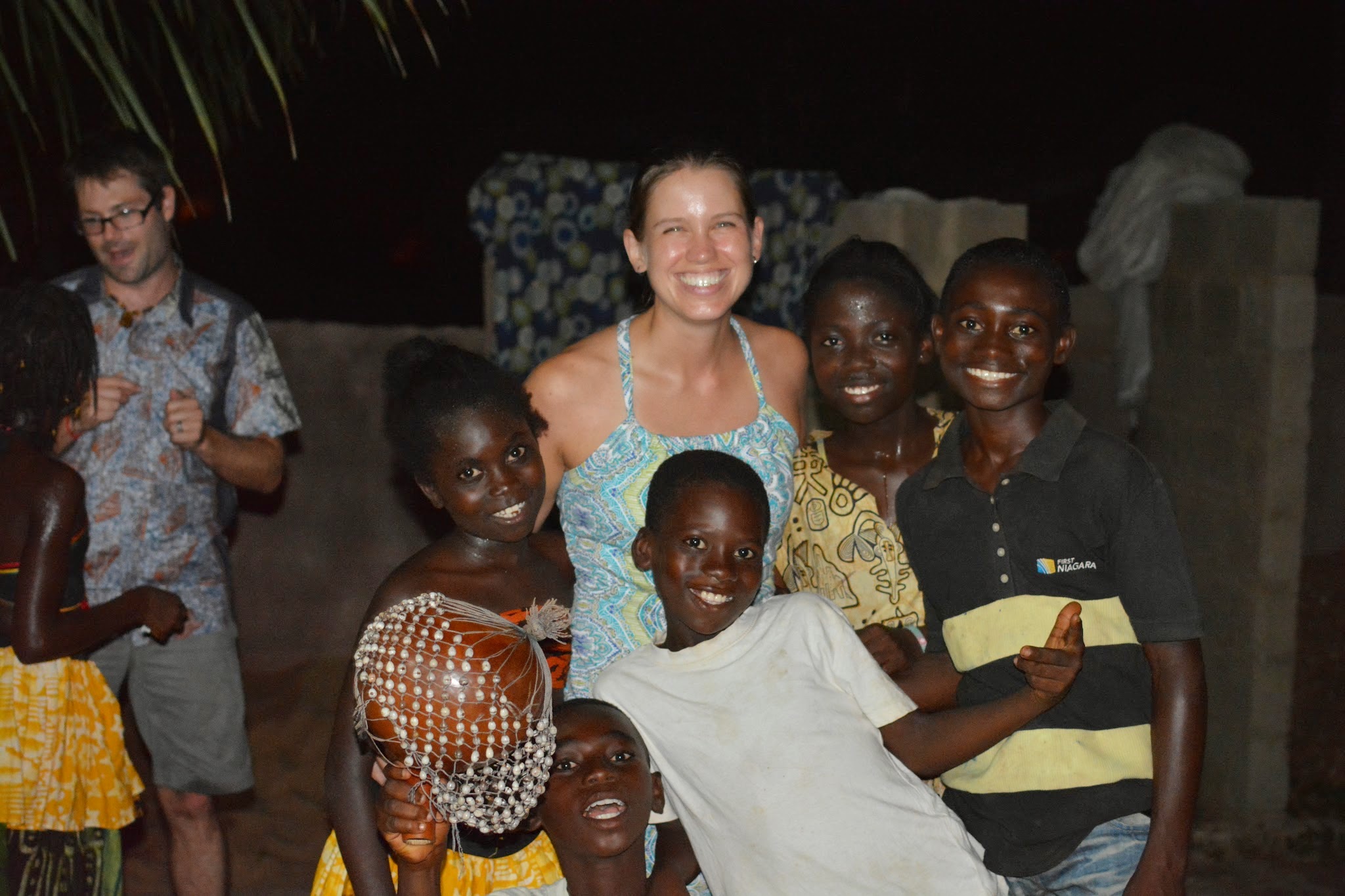
The following evening, we arrived at the bar promptly at 6 PM. (OK, it was more like 6:15 PM, and still we were so early that they didn’t know what to do with us. — Africa time is a thing.) And so, we sat for a bit sharing a beer. (We were told to be mindful of how much beer we drank because there was a lot of food to eat for dinner). A girl, maybe eight years old, plopped down in the chair next to us. “I’m a free spirit.” “Oh wow,” I said. I thought this was an impressive declaration for an eight-year-old, and it had me wondering if I, too, was a free spirit. But then we learned that all of these kids are Free Spirits. They are all involved in a foundation that helps support the drum school, their care and transportation, and occasionally helps some of them travel overseas to perform — several of them had been to Poland and most of them are traveling to the US in March.
Then Kobi showed us their “kitchen” — an incomplete building where the bar manger was bent over three small coal fires. Kobi explained that with the amount of money we had suggested, they had decided that they would just feed the whole school and cook it themselves — and so (due in no small part to the ingenuity and grit of Kobi and his manager) for what we spent at one dinner at a fancy resort, we provided dinner for the four of us adults and 13 kids. And the dinner was no basic affair. There were multiple courses including a soup (which, as we’ve mentioned, is eaten with one’s hands), fried and baked plantains and cassava, red beans, and both fried fish and chicken. But before dinner, there was the show — kids having a ball drumming and dancing for their audience of two — though several local kids came by to see what all the excitement was about. At the end of their last song the girl dancers grabbed us and dragged us onstage, and proceeded to try to teach me to dance.
“No. Put your hand here. No, there. OK. OK, now move your other hand like this…ummm, no, looser, yeah, looser…umm ok.” (Shakes head in resignation of imperfect white girl hand moving.) “OK, now move your body…MOVE YOUR BODY…” (Actually turns and walks off,) proving, empirically, that white girls cannot dance, and that they may in fact be a lost cause.
The Show:


And Dinner:


Finally the beach you see below our feet is Camp’s Bay Beach, which was so beautiful that we had to make it our next stop. Down the mountain and straight for the sand. The view of Lion’s head, which we had just summitted, from just outside out beach umbrella was impressive.
If you ever have a chance visiting Cape Town for Lion’s Head hike, I highly recommended it. Just might want to visit during a less crowded time than Christmas and New Years, as everything is packed even the trails.
Ghana was the first African state to declare independence from European colonization. There have been peaceful hand-offs of power from one legitimately-elected head of state to another since 2000, making Ghana among the most stable states in Africa. The last three US Presidents have visited the country. President Obama and his family visited in 2009. Here are some notes about our time here so far:
1. The power was out all day on Tuesday in Cape Coast, because it was Tuesday. (Cape Coast is the former British capital and home of the infamous Cape Coast Castle through which millions of slaves were loaded onto slave ships bound for the Americas through the Door of No Return. We visited the castle on Tuesday. President Obama unveiled a plaque at the castle in 2009.) There was no power or water in our hotel room Tuesday night, because, TIFA. It’s not the first time we’ve run into power outages on the trip, and it likely won’t be the last. And when I lived in Honduras, this kind of thing happened all the time. But, still. Next time you walk into your bathroom, flip on your light switch, and wash your hands in the sink, just think about all of the things that have to go right for that to happen — the power and water have to be available, the government has to not fail at getting them to your house, and then the wiring and plumbing in your house have to enable it to reach you.


2. There is a name for the weather pattern that is happening right now in Ghana, when hot wind blows the sand in from the Sahara, coating everything in a fine layer of dust — harmattan. December in Ghana is hot. So, without power, even if you sit completely still, new beads of sweat still form. On the plus side, our laundry dried in a day.
3. In Ghana, as in Honduras, you can buy drinking water in bags. This is brilliant. Think of all the times you have an empty bottle and you just need to refill it. Or all the times you are hot and thirsty and you just want to slam some water and not be burdened with carrying around the bottle looking for somewhere even slightly environment my friendly to put it. Also, we can buy 15 liters of drinking water for the equivalent of slightly leas than 1 USD. I think this is partly because it is a commodity that so few tourist buy in bulk (why?) that locals are thrown off their game when we ask for it, and just charge us the standard local price. (Note: this happens with nothing else.)


4. The beaches are really quite pretty, especially from a distance. They’d be much nicer if they were cleaner and were not required to include public bath and toilet among their various uses.


5. My vertigo has become more intense as I have aged. Which meant that there were times when I was legitimately freaking out during the rain-forest canopy walk at Kakum National Park.


6. Though we were unimpressed with the reggae at world-famous Big Milly’s in Kokrobrite, their cultural drumming and dancing night was incredible, all the more so because the show was not put on for us, at least not entirely — the entire village was in attendance.

7. The adorable baby goats running around all of the towns have convinced Dan to become a goat farmer. Anyway, when you visit us and hear the baa-ing, at least you will know what that is all about.

8. Our “VIP” air-conditioned bus from Accra to Cape Coast began with 20 minutes of preaching and group hymns
followed by 20 minutes of biblical trivia. Unfortunately, both were conducted in Twi, which, in addition to being a language we do not know, is a tonal language we do not know, so we were unable to join in. On one hand, it is nice to have a group of people praying with you as you think, “Please, God, do not let anybody steal my bag from under this bus, and please do not let this bus topple over as it swerves to avoid the potholes.” On the other hand, particularly as the preaching entered it’s second half hour, Dan was longing for a greater separation of church and state, and I have to admit that it is a bit disconcerting that across Africa (we ran into a similar group prayer/song to Allah on the ferry from Dar es Salaam to Zanzibar) — the safety of your journey is entirely in the hands of God or one of his sons.
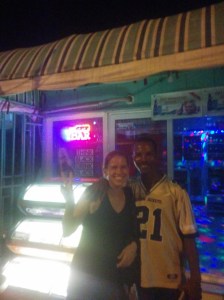
9. One night in Cape Coast, Dan and I bought a round at a neighborhood bar, for everyone in the bar. For $1.75, including tip. The whisky did come in bags.


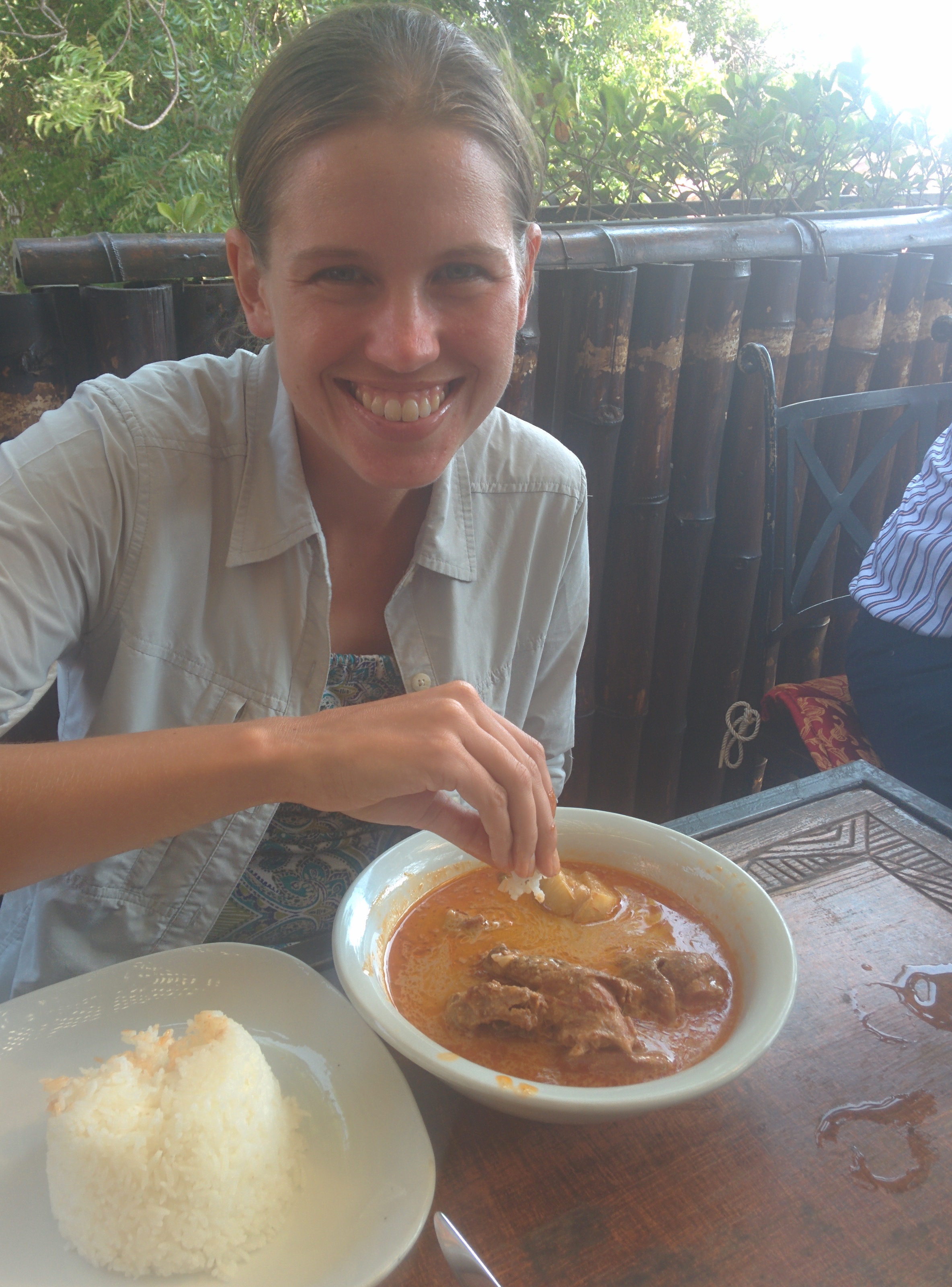
10. In Ghana, people eat their delicious ground nut soup with their fingers (there are hand-washing stations at the tables). It still grosses Dan out, something about the dirt under your finger nails slipping into the soup. It is best with what is sometimes called banku, but goes by other names as well — fermented maize dough.
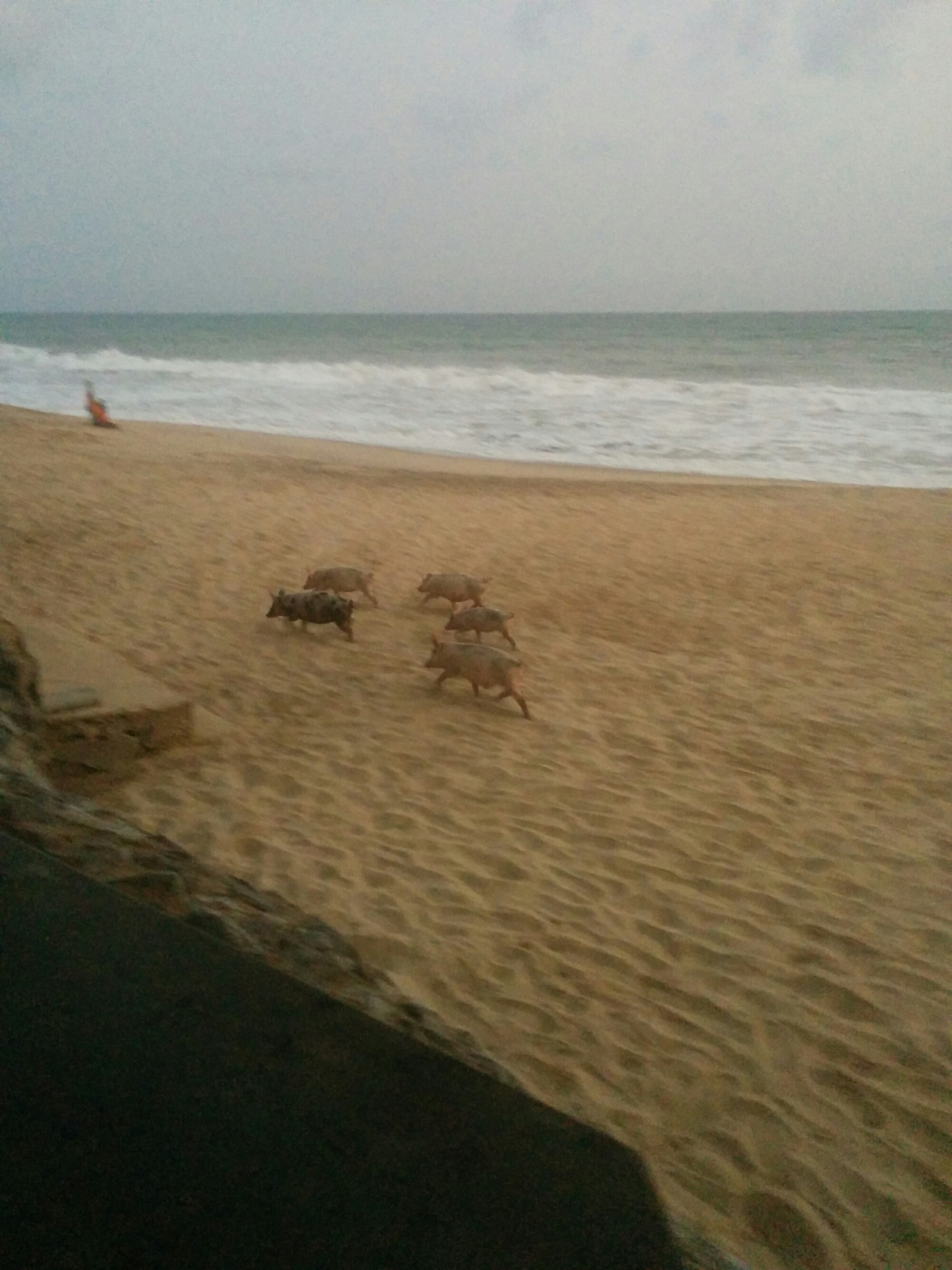
11. Many of the kids we see in the villages are happy. Some are reasonably well off, though most are not. Some are malnourished, but the vast majority are not. Most wear shoes, but some do not.

Ghana Must Go is a good book, particularly in its descriptions of Ghana, and it includes references to Kokrobite and Big Milly’s. You should read it. This is one of my favorite parts:
“The child was smiling brightly, possessed of that brand of indomitable cheerfulness Kweku had only seen in children living in poverty near the equator: an instinct to laugh at the world as they found it, to find things to laugh at, to know where to look. Excitement at nothing and at everything, inextinguishable. Inexplicable under the circumstances. Amusement with the circumstances.”
And a bit later:
“Later in America he’d see [those kind of eyes] again, in the emergency room mostly, where eleven-year-olds die: the calm eyes of a child who has lived and died destitute and knows it, both accepting and defying the fact. with precisely the same heedlessness the world had shown her, and him, all dirt-poor children. The same disregard.”
Just a view of the beach from Cape Coast Ghana, at castle restaurant. A nice moment to lighten the mood. After our very depressing tour of Cape Coast castle one of the largest exporters of slaves. A place made even more famous, when Obama visited a few years ago. I will say both tourists and locals come to the tours and seem to leave believing in a better future than our past.
There are far too many thoughts, to really ever sum up our safari in one post. I am sure we will make a couple posts over time about specific parts of the trip, or reviewing G adventures whom we did the trip with. In the end though, there is an overwhelming amount of feelings and thoughts that you have over a 24-day overland Africa trip. I won’t begin to try to cover it here, but I did want to write out a few thoughts before they fade from memory. (From Erin — the long and short of it is that it is awesome and you can totally hang. [Even we totally hung, and if you ask around, you will find that I am not low maintenance.] If you are thinking of doing a 24-day overland African safari…just do it…it will be amazing. Sure, sometimes you will be uncomfortable, but mostly, it will be just fine. We had a good time on our G Adventures tour — one awesome guide and one fine guide. We are guessing that other operators do it just fine too. Find an operator with a sale going on, and just book it.)
1. A safari is like a really long unedited version of Discovery channel.
Seriously, all the things you see on animal planet are real, and common — not even that hard to find. You can find a sleeping lion next to it’s kill with baboons taunting it for fun, while a jackal tries to creep in and steal some loose meat from the kill.
2. You will appreciate zoos a bit more
I am not talking about sad zoos that mistreat animals. I am talking about ones with breeding programs for endangered animals. Ones that are helping study animal behavior in responsible ways. Even things like Disney’s animal kingdom, which is massive, and really simulates open wild game parks. There are tons of animals in the wild having their habitats split up and destroyed in ways that will decimate the animal populations. Without study and intervention, some species will die because we don’t understand their migration patterns and we destroyed a part of it.
Some of the breeding programs are the best bets to help some animals survive. Also, when an environment is built really well it can help study animal behavior in less invasive and destructive ways than completely invading the space of the few remaining wild groups of animals.
Finally, having seen some animals in a zoo and as a child, I thought the animals just laid around boring like that because they are in captivity — so not true. Free and wild lions will sleep 20 hours a day, and really don’t give a crap about tourists or most other animals if they aren’t hungry at the moment. So, what you see in a good zoo is a pretty accurate sample of their lifestyle. If you are at a humane zoo, you can see real animals behavior without hours in a hot truck. I am not saying that zoos are the same as safaris, or that we don’t need protected parks if we have zoos, I am just saying that good zoos can be part of the overall solution to protect and fund habitats for the planet’s animal population.
3. Everything is 50/50 in Africa.
4. After the Safari I have come to appreciate some things much more than I used to, a few examples below:
5. You will watch something amazingly beautiful and brutal at the same time
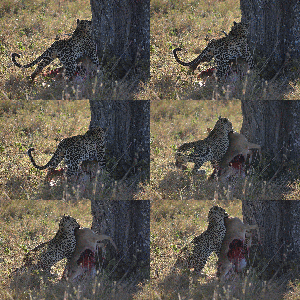
Probably the most interesting thing we watched on safari was a leopard that carried it’s Red Buck kill across the road and then up into a tree. It was pretty incredible to watch and it seemed a bit odd to so casually watch the rawness of life.

“When you see a herd of animals with a predator nearby, you always cheer for the prey. ‘You can do it, run, run…stay together… ‘ but once it is obvious that the predator is going in for the kill, you begin to cheer for the predator, ‘kill, kill,’ because you realize that the lion is hungry… and you want to see it happen.” -Erin








Basically just like DC, except, you know, the tree is a bit small, it is way warmer, and we got to dance in a conga line to “Come all ye faithful.”


 Adventures of the Miller Mayers