We’ve all survived our first month — something that feels like a genuine accomplishment made possible by Dan’s mad fathering skills and the tremendous amount of support we’ve received from family and friends.
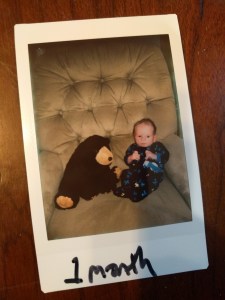

We’ve all survived our first month — something that feels like a genuine accomplishment made possible by Dan’s mad fathering skills and the tremendous amount of support we’ve received from family and friends.
Just kidding — it took until 7:30PM to get the two of us bathed and clothed, and the shirt I was wearing already smelled of breastmilk. But at least we got some pictures.


We’ve all survived baby Theo’s first week.
Dan gets an A+ for rocking at fatherhood — he can change diapers, navigate hospital bureaucracies, provide supplemental feedings, do all our dishes, and make sure mom gets extra sleep.
Theo gets a B+ — he’s an adorable little baby but he beat up his mom pretty bad on the way out, was small for gestational age and lost significant amounts of weight over the first couple of days — but he’s been gaining weight and starting to get the hang of things over the last several days.
My grade is decidedly the weakest — a gentleman’s C for still being alive (though Dan argues that surviving has required more than that and deserves a higher grade). I did spend an hour in the operating room under anesthesia after Theo’s birth for repairs after the delivery and then was readmitted five days after the birth for postpartum preeclampsia, which required being strapped to an IV that dumped magnesium sulfate into me for 24hours. Magnesium sulfate makes you feel awful — dizzy, pounding headache, nauseous, and unable to eat solid foods. But, on the plus side, I didn’t have a seizure.
I was re-discharged on Sunday and we are just starting to get into a routine at home. Today was our first day without a visit from a nurse and we celebrated by going to lunch at our neighborhood pub — and we even got there before 3PM.


Things that we would love as we prepare our house and hearts for the arrival of our baby boy at the end of February:

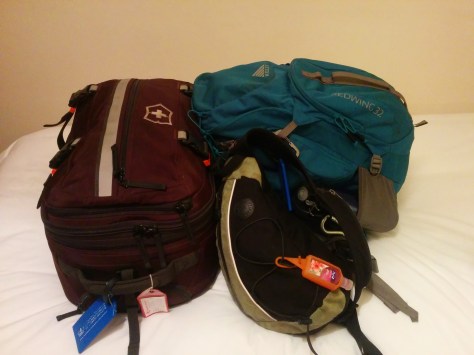
A note about the ordering — this is the order I always pack in — tech items and incidentals, kit bag, clothes. (Also smallest bags to largest). I know many fine folks who go in the opposite direction, so feel free to start from the bottom.
We technically packed the absolute largest carry-on size allowed by international carriers, but because of liquids restrictions and my desire to have a pocket knife for food preparation, we generally checked our main bags, which allowed us the luxury of two carry-ons. So I would often pack a smaller, front-carry sling bag, to put under the seat, and stow my larger backpack in the overhead bin.
Final note — this is obviously all from a chick perspective. Men should adjust accordingly. Dan carried slightly more of the adapters and tech gear, used a packable backpack instead of a shoulder bag, carried a water purification system, and carried the extra sunscreen.
Sling Bag
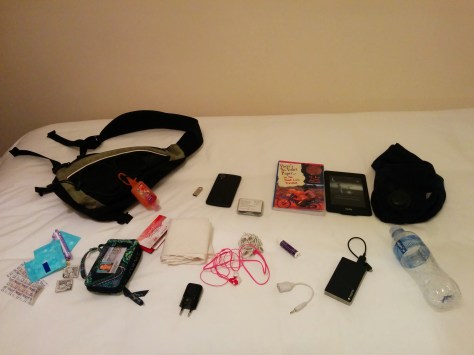
First, the bag. I LOVED my old sling, but after 10 years of consistent use and one epic trip, it absolutely disintegrated. My old one went cross-body over my left shoulder, easily slung around to my front (when walking on a crowded street, boarding public transit, or using a squat toilet), and had an optional waist strap which helped relieve the burden of particularly heavy, liquid-filled loads when hiking. I haven’t found anything quite like it. I tried this Waterfly bag. It has some advantages over my old bag including a water-bottle holder, its price point, and that it collapses for packing. But, I found the lack of structure or a real waist strap to be deal breakers. I ran into a fellow traveler here who raved about her Patagonia Atom Sling, and I might give it a try. It lacks the drawstring for additional storage that my old bag had, and it’s waist strap is somewhat less usable. Does anyone out there have any other recommendations?
What’s in the front sling bag?
Backpack
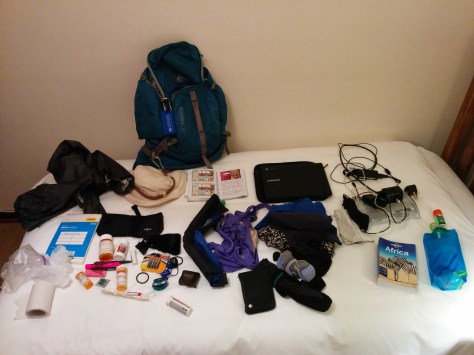
The bag — just find one that works for you and fits you well. Mine is all right, but I didn’t LOVE the fit.
What’s in it?
Main Bag
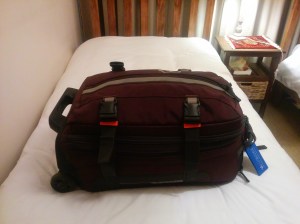
Alight, on to the main bag. First, again, the bag. We went with these: The CH 22 Tourist Expandable Carry-On, based on an argument made on a great travel blog whose domain has since expired. It meets most carry-on requirements, barely. Part of the reason I went with it was that the square-ish corners offer more internal space than similar bags with round corners. Also, I didn’t really want a bag that came with a day pack, since I wanted to find a backpack that really fit me. We never once used the backpack function of the bags, which might really say a lot — we dragged our bags through Asian metro stations, over the beach in Ghana, and stored them for two weeks in the bottom of our safari vehicle (we only used small expandable duffel bags as our day-to-day bags on the safari). And they held up pretty well. Still though, I like the comfort that a convertible brings, knowing I could use it as a backpack if I ever really needed to. All of this said, and Dan and I spent our whole trip RTW coveting these bags, just like our friends said we would. If I were to do it again, I don’t think there is anyway you could talk me out of the Meridian Travel wheeled deluxe luggage, 60 Litres.
What’s in it?


What you should plan to be wearing during your travel day? Good, comfortable travel pants (probably not zip off since you are about to be on a bus or a plane for a long time and those zippers can be annoying), a travel short sleeve shirt — a good time to bust out one of your icebreakers — I LOVE my cool-lite crew, (a t-shirt works better with your backpack on than a tank top), and one long-sleeved travel over shirt.
And, your kit bag, including:
TL; DR: This is the post that I wish I’d been able to read before we decided to go on our trip around the world.When we were still deciding whether to pull the trigger, we would look at the travel blogs of our friends and of complete strangers and we would be awed at their pictures and amused at their adventures, but I’d always wonder, now that you’ve been back home for a year, are you glad you did it? Was completely disrupting your life to travel around the world worth it? For me at least, the answer is a resounding yes.


The time you spend traveling will pass so fast — what’s six months, or even a year, in a lifetime? And so, I think that what you gain from that time traveling is much more than what you lose by skipping out on six months of meetings, and house shopping, and bad television, and even friendships back home. And what is it, exactly, that you might gain? Perspective, I think, and confidence. And things you learn about yourself and your travel partner and your relationship. As in most things, though, I think there is likely a diminishing marginal utility to extended travel. You are likely to gain the most from the experience if you haven’t traveled or lived outside your home country much in the past. And the first six months of the trip are likely more valuable as a learning experience than the next six months, and much more important than the next six months, etc. Of course, I have a biased perspective on this because we only traveled for about 6 months, but I would say that we were learning less about ourselves and the world at the end of that time than at the beginning. (Though we were still having a blast.) And I would guess that if you spend 18 months traveling, it would be hard to resist the temptation to just set up shop on a nice beach and take an extended vacation for a time — which sounds lovely, don’t get me wrong, but probably won’t teach you as much about yourself and the world as does taking the trains through Japan, riding a motorbike in Vietnam, or taking a taxi through rush hour in downtown Nairobi. Also, I would say that Dan gained slightly more from this trip than I did, largely because, I think, he hadn’t spent as much time outside the US before. The traveling is incredibly doable, and very worthwhile.
The thing that demands real respect is the disruption to your life. If you’ve traveled or lived outside your home country for an extended period of time before, then you are likely fairly prepared for this, but it is still worth mentioning. Re-entry is tough. And it’s tougher as a married 30-something young professional than it is as an undergraduate study-abroad student or a kid going on an adventure between undergrad and grad school. We lived in my parents’ basement when we got home. They were gracious and wonderful, and it was tough. Looking for a new job is stressful, and looking for a place to live at the same time is almost overwhelming — not that people don’t do both of these things all the time for much more “real” reasons than returning from a trip around the world. Some advice: if possible, I think it makes sense to time your trip with a planned move anyway. I still miss my friends and colleagues and the community that we built in DC — moving to a new city and building a new home is hard no matter what, so you might as well take six months and travel the world. It meant that I spent a few months unemployed in my parents’ basement, whereas if we’d left straight from DC to Denver, I would have lined up a job before the move — but in hindsight, those few months of uncertainty, which were hard, were worth it for the trip. Also, it was helpful that Dan was keeping his job — so we had some income coming in almost immediately after we returned to the States.
From a professional perspective, I don’t think the trip set me back much, given that we were moving across the country anyway. Most people are impressed with the trip and it provides a nice topic of conversation. In going over my resume, not once did I hear the question, “why did you do that?” The usual response is, “that’s incredible, where did you go?” Again, just my sense here — but I think people are more likely to understand a trip that is 6 months to a year than one that is much longer than that. I’ve met three people who I work closely with professionally who took similar trips. It’s amazing to be able to reminisce about the hikes in Cape Town, the ramen in the basement of the Tokyo metro station, or the night bus to Phnom Penh over a first get-to-know-you coffee. And I have a reputation as a capable traveler among my colleagues, and so I get to spend some time offering advice about vacation itineraries and gear — both favorite topics.


So, here we are a year later. (Well, a year and couple of months — it’s hard to find time and energy to sit down and blog now that we are gainfully employed.) Our dog has forgiven us. We have a great house in a neighborhood we like. We both have jobs that are challenging and that we enjoy. And we are working on building our Denver community. We feel like we are in about the right spot for us. And we have the bonus of the perspective and confidence and relationship built over six months of fairly challenging and completely incredible travel. It was totally worth it.
Edit #1; 2-23-16 — Have now met three people in a professional capacity who took similar trips.
We are at it again, on a mini version of our previous world tour — Arusha, TZ —> Istanbul, TK –> Amasra, TK –> Athens, GR —> Kardamylli, GR. And right now we are catching a 2AM flight out of Kilimanjaro airport to Istanbul. We have some extra data on our phone. What to do with a bunch of extra gigs at the airport in Tanzania? Upload a few pics of our trip so far. In related news, the Kiswahili word for foreigner means, “one who walks in circles.” Fair enough.


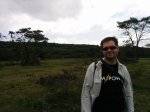


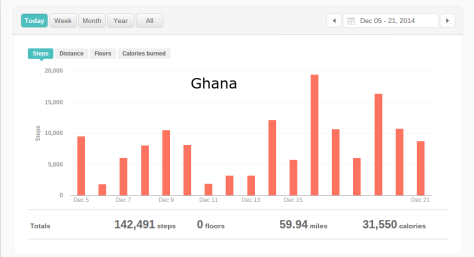
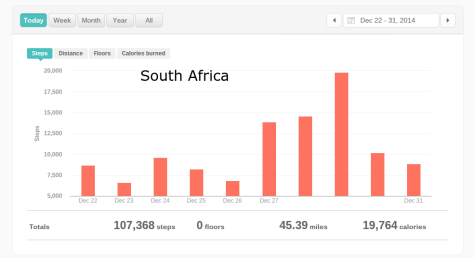
Our friends noted that they wish they had brought an activity tracker on their RTW trip. So, I wore a Fitbit (specifically, a Flex). I wasn’t perfect about wearing it and it ran out of battery a couple of times, but I wore it pretty much every day.
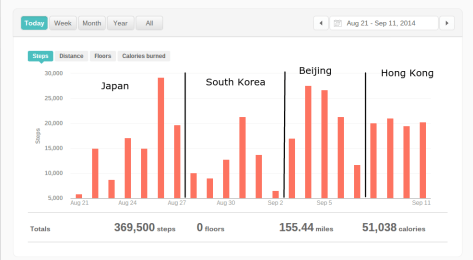
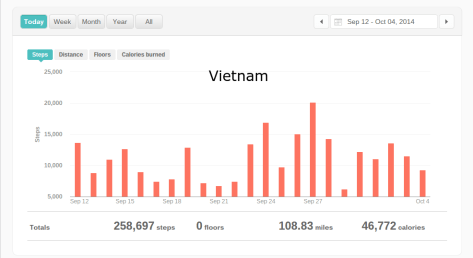
What we learned: We walked 1,637,488 steps on our five-month trip through Asia and Africa, the equivalent of about 689.57 miles. Our most active day was spent chasing the gorillas through the Ugandan bush. We walked 36,565 steps that day (about 15.4 miles).
Graphs below. Please note the scales — I couldn’t get Fitbit to export my data on a consistent scale, so the graphs require a bit of interpretation. 




Edit: Update to include another link in the water vs paper debate in #3.
For better and worse, here are some of the things that surprised me during our five-month trip through Asia and Africa.
1. The world is a really big place, like a *really* big place. I know this sounds naive, but one of the most surprising things about our trip was that even though we took more than five months off work to travel, we could see only a fraction of the world. Even once we narrowed our itinerary to “just” Asia and Africa, we still had to be brutally choosy about the 13 countries and the cities that we got to see. Just off the top of my head, if we had had the time, we would have wanted to see more of rural China, perhaps taking a train from Beijing to Shanghai, we would have spent even more time in Vietnam, perhaps exploring the rice paddies up north and definitely getting to Phu Quoc, and we would have spent more time in Egypt, including spending time diving diving up north. And if you start adding additional continents into the mix, we would really like to have made our way to Eastern Europe, including Croatia. And, did I mention that I studied abroad in Italy? I could have taken Dan around Italy for a month with one hand tied behind my back — it would have been much easier than all the traveling we did where every country was somewhere neither of us had been before and we often didn’t know more than a few words of the local language or any of the customs around transportation.
2. Honduras is poor, even relative other less developed countries. Living and working in Honduras in 2006, I understood that the country was poor, but it was not until this trip that I gained an understanding for exactly how poor it is relative to most of the rest of the world. Throughout our travels, we saw the occasional barefoot kid with a bloated belly (early sign of malnutrition), the occasional thatch-roofed home (thatched homes are often leaky and riddled with bugs, which is why, given the opportunity, people rush to get a tin roof) and the occasional girl carrying a jerrycan of water down the highway (transporting water by hand/on one’s head takes a lot of time and energy and can be dangerous). (FWIW, along our route, these sites were most common in Cambodia, Uganda, Kenya, and Ghana.) But despite traveling overland through fairly rural areas, we rarely saw these sites at the frequency that we saw them in Honduras when I lived there. And we saw a lot more agriculture (Uganda, in particular, is famous for its soil quality) and livestock (water buffaloes in Cambodia, and cows, chickens, and goats throughout Africa) than I remember seeing in Honduras. I realize that our anecdotal experience is limited, but UN data seems to lend some weight to our observations. Honduras is #129 on the Human Development Index, and Cambodia, Ghana, Kenya, Tanzania and Uganda all fall within the next 35 ranked countries out of the 187 countries with complete data. Their Human Development Index scores are all with .15 of one another and their Inequality-adjusted Human Development Index scores are even closer, within a range of .1. All of the other countries we visited on our trip, including Vietnam and South Africa, felt substantially more developed than Honduras, and the data support that observation too. It seems important to keep these facts in mind when politicians talk of sending unaccompanied minor immigrants from Honduras back to the country they fled.

3. I was less welcoming of some cultural differences than I thought I would be.
But this is where I get hung up. And maybe it was only because we were traveling and so often both in a rush and carrying a lot of bags into bathrooms, but there was water, with some amount of fecal matter in it, I can only assume, splattered ALL over some of the public restrooms. I don’t exactly understand why so much of the bathrooms are wet — the entire toilet and the floor around it, but as Svan noted, they really do get wet. Perhaps this is more of a problem for women too, who are often using the toilets for what would be a less intensive activity except that as soon as you approach one, you have fecal-matter water covering your shoes and threatening anything else you are wearing or carrying. I hear Svan’s other arguments, but my damp sandals and the damp pants that I would be wearing for the next 11 hours on a bus wouldn’t let me get behind this cultural difference.

4. For his part, Dan was surprised by how well, relative to some countries, our government works. While it’s fair, and even patriotic, to demand a better government — one that protects and supports more of its immigrants and one that rummages through less data on innocent civilians — after just a few days without power and running water, all the while negotiating police contributions, you realize that for all it gets wrong, our country gets a lot right.
5. The world is not, seemingly, marching towards a more “western” future. In my own naive, American, way, I had this default notion that the world was generally becoming more “western,” more open, more capitalist. Like, if we just sat back and waited, the world will move naturally towards a more open future. And while some places are experiencing a dramatic growth in capitalism — the economy in Vietnam is an incredible thing to witness right now and you can literally feel the middle class buzzing underneath you — some places are not. While traveling in Malaysia, we had a sense that the country was once more open than it was on it’s way to becoming. We were there during Deepavali, and as a Hindu holiday, it was still celebrated and recognized as an official holiday, but we heard more than once about the growing power of the morality police — a special police force enforcing special laws on the Malay-Malay Muslims in the country (who are not allowed to exit the Muslim religion). The government there is a big supporter of technology companies, but we heard that if foreign tech companies visited, and hosted events that included alcohol, (something perhaps expected with Western companies entering a multi-ethnic and multi-religious country) then anyone who is paid by the government (and the government supports most of the tech companies and employees in the country) would be prohibited from attending the event, even if she helped to plan and coordinate it.
6. Our college-educated (and generally amazing) safari guide expects his future wife to go to a week of “wife school” before marriage. I feel like perhaps I haven’t said enough about how amazing our guide was — we had a friend who had been on seven similar group trips over several years, and she said that this guy was the best guide she had ever had. So yeah, he was amazing. But this week of wife school is not, in fact, all a hen party (though our guide couldn’t rule out the possibility that there might be one night of hen partying); it is really a week-long course in how to be a wife. We later learned that the wife school is a kind of substitution for the events that used to take place around female circumcision. Because female circumcision is no longer practiced in our guide’s tribe, wife school is a way of maintaining some of those traditional teachings. +1 for wife school.
7. There really might be either a parade of elephants or a cackle of hyenas between you and the bathrooms when you are camping in the Serengeti. There are no fences around either the Serengeti game park or the campsites inside it, and also, there are no lodges. So, everyone camps, even folks on the fancy tours camp. This means that our camping was taken up a notch from the usual set up. Someone set up our tents for us, provided us toilet paper, and cooked our dinner (this may have also been related to the fact that the kitchen was located inside a cage). So, we arrived right at sunset and had no work to do. Naturally, I started drinking the whisky we had brought. And then, at dinner, our guide announced that a beer truck had come by the campsite. In a lot of parts of Africa, the economy just didn’t work in the way I expected. For example, we couldn’t find any woman (or man) willing to do our laundry in Zanzibar — even if we were willing to pay generously, and they were currently doing their family’s own laundry. And in South Africa, we not once, but twice, arrived at a winery, that was open, but that wouldn’t let us buy any wine. So I was completely impressed with this Serengeti beer truck and more than a little eager to support this young entrepreneur by purchasing two five-dollar bottles of Serengeti beer. It was after the whisky and half-way through our beer that our guide started going over the necessary safety precautions one must follow if you need to use the restroom in the middle of the night at the campsite. Wake up your tent buddy and make him go with you, bring your headlamps and flashlights and shine them in front of you, talk the whole way. If you see something with two eyes close together moving toward you, shine your light at it, and back away slowly. Dan immediately started dehydrating himself. I finished my beer and drank some water, and woke up at 2AM with a desperate need to pee. I woke up Dan. We walked towards the bathrooms (which are also located inside a cage), and that is when we saw the group of hyenas, and at least two of them began slinking towards us. We retreated, waited in our tents for about 45 minutes (which felt like 5 hours on a full bladder) and then again made our way to the restrooms, satisfied that the hyenas had backed off a bit. So yeah, when you are camping in the Serengeti, I still recommend supporting that beer-truck kid, but perhaps skipping the whisky.


8. Traveling the world is incredibly doable. I was shocked at how doable the whole thing felt. Yes, it takes savings and planning and taking some care (sign up for STEP), but if you are considering it, then do it. I am not a low-maintenance person. I brought three different types of hair products. I brought two travel pillows so that I could always sleep with three pillows — like this. I have sensitive skin. I’m freaking allergic to aloe. It goes without saying that I’m allergic to a lot of laundry detergents, and so, whenever we were able to pay someone to do our laundry, I would have to re-rinse and re-dry my underwear. I am not a champion sleeper, but I slept like a baby in those safari tents (once I learned to stack up two of the safari mattresses). I’m telling you, if I can do this, almost anyone can. You won’t remember the ants in your hotel room or the biting flies on the safari…well, I mean, you will, but those memories won’t compete with the noodle bowls, the great wall, or the site of a leopard dragging its kill up a tree. Find some good travel-sized hair products and a very patient travel partner, and go.


Last night, we watched the rodeo at the National Western Stock Show while enjoying a local Colorado brew. The mutton bustin‘ was pretty cute.


 Adventures of the Miller Mayers